PROGETTO TOPPUNT
Cristiano Pallara


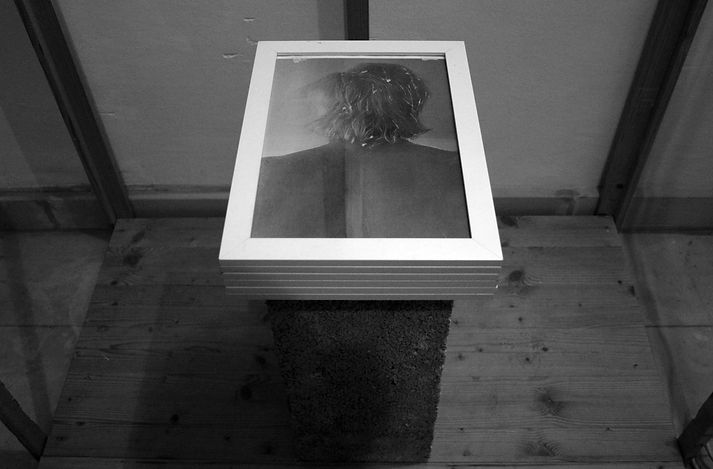
Una singolare, e funesta, coincidenza è all’origine di Valediction di Cristiano Pallara. Esattamente tre anni prima dell’esposizione a PROGETTO TOPPUNT, nello stesso mese (novembre), Cristiano Pallara esegue una serie di scatti fotografici al padre. Una band gli ha commissionato la copertina del nuovo album, e l’idea è di utilizzare il ritratto di un anziano. Cristiano Pallara decide di fotografare il padre, settantenne. Le foto sono essenzialmente ritratti ridotti al volto, la fronte il profilo la nuca. La settimana successiva al servizio fotografico, il padre muore. Ecco, il dato biografico, la forte connessione tra l’opera esposta e il vissuto dell’artista, è il primo dato di Valediction. A PROGETTO TOPPUNT, Cristiano Pallara non ha portato le foto, bensì le fotocopie delle foto; e dei disegni, del volto e del corpo (entrambi segnati dal tempo) del padre. Questi disegni sono stati realizzati seguendo, e premendo, con un chiodo (un chiodo!) le immagini fotocopiate, sotto le quali erano collocate in ordine, prima la carta carbone, e poi il foglio che ha raccolto il ritratto. Le immagini fotocopiate non sono uscite indenni dall’operazione: sono state incise, tagliate, dal chiodo premuto per lasciare un segno ben visibile. Nel parallelepipedo di Toppunt, la piccola sala espositiva, le fotocopie e i disegni, hanno costituito il recto e il verso di quadretti (ne ho contati sei) non appesi, bensì accatastati su un mattone da costruzione al centro del solido. Solo il foglio-carta carbone, con l’intrico di linee di tutti i ritratti, un’intersezione di linee che non si scioglie in un’immagine definita, era appeso frontalmente a colui che guardava. Il tema del soggetto (il contenuto) e del trattamento artistico del soggetto (la forma), che anche se separabili costituiscono un tutto-uno inestricabile; di questo mi sembra parli Valediction. Certo, è anche un commiato, e un compianto, per il padre che non c’è più (con cui forse non si sono chiusi i conti; una regola generale, chissà). Ma anche un’azione artistica, all’insegna della morte, con una connotazione simbolica, che chiama in causa la memoria e il ricordo. I primi due gradi dell’opera (la persona in carne e ossa, le foto della persona) non c’erano. Allo spettatore erano accessibili una copia della copia della copia e un garbuglio senza capo né coda. L’originale non c’è più, e il dolore della perdita ha generato una cascata, in cui il tempo, con la pazienza dell’acqua dilava la fallacia costitutiva (ontologica) della memoria e le incrostazioni non limpide sui ricordi già alla sorgente. L’opera dà conto di tutto ciò.
Valediction si riallaccia alla prima esposizione di questo ciclo di PROGETTO TOPPUNT, l’opera di Pasquale Marinelli, dal titolo 80034. Il filo conduttore di quella, anch’essa a connotazione biografica, erano i legami tra le persone, legami che si fanno e si disfanno a vari gradi. La coincidenza del dato biografico, trasposto artisticamente, ha aperto e chiude il cerchio di questo primo ciclo di PROGETTO TOPPUNT.
14 | 11 | 2016
A tragic and unusual coincidence is at the origin of Valediction by Cristiano Pallara. Exactly three years before his exhibit at PROGETTO TOPPUNT, in the same month (November), Cristiano Pallara realized a series of photographs of his father - a band commissioned to him the new album cover, and the idea was to use the portrait of an old man. Cristiano Pallara decided to photograph his father who was seventy. The photos are essentially a portrait reduced to his face (the forehead, the neck, the profile). The week after the photo-shoot, the father died. Here it is, the most important part about "Valediction" it's a biographical information, the strong connection between the exhibited work and the artist's experience. At PROGETTO TOPPUNT, Cristiano Pallara did not bring any real photos, instead he brought the photocopies of the photos; plus some drawings of the face and of the body of the father (both marked by time). These drawings have been realized pressing with a nail (a nail!) following the lines of the photocopied images, under which they were placed the carbon paper and the paper that has captured the portrait. The photocopied images have not came out uninjured by the operation: they were engraved and cut by the pushing nail, leaving a visible mark. Into Toppunt's parallelepiped, the tiny exhibition room, the photocopies and the drawings formed the recto and verso of six squares which were not hang out, instead they were stacked on a building brick at the center of the structure. Only the carbon paper, with its maze of lines of all the portraits - a crossroads of lines not dissolved in a defined image - was hung frontally to who was watching. The theme of the subject (the topic) and of the artistic processing of the subject (the form), although divisible from each other, they form an inextricable whole. As I see it, "Valediction" seems to deal about this. Of course, the work is also a mourned farewell to his father (with whom perhaps he was not yet done with - a general rule, who knows). But also it's an artistic action, dedicated to the death, with a symbolic connotation, which involved the memory. The first two levels of the work (the person in flesh and blood and the picture of the person) were not there. To the audience what was available was a copy of the copy of the copy, and a mess without beginning or end. There's no an original version, and the grief has given origin to a waterfall, in which the time, with the patience of the water washes the (ontological) constitutive fallacy of memory and the already dirty crusts on the memories at the source. The work is accountable of all these things. There's a connection between "Valediction" by Pallara and the first exhibition of Toppunt, "80034" by Pasquale Marinelli. The theme of that work, which also got biographical implications, were the connections, the relationships between people, bonds made and dismantled on different degrees. The coincidence of the biographical information, artistically transposed, has opened and has closed the circle of this first cycle of PROGETTO TOPPUNT events.